
Participation and recordings
Cameras are optional, and no one will be called on unexpectedly. The first 50 minutes will be recorded; open discussion will not.
A five-week live online course
Five Tuesday evenings with Homer’s Odyssey
Interpretive lectures, close reading, historical and literary context, and discussion. Read or listen to the whole poem, or follow the course through a weekly guide to key passages. Join the conversation or simply listen; speaking and cameras are optional. No previous experience with Homer is required.
Now open for registration
Course description
Most of us encounter The Odyssey first in fragments: the Cyclops, the Sirens, Penelope at her loom, a man struggling to reach home. This course returns to Homer’s poem itself—to its active gods, nonlinear storytelling, divided hero, unsettled household, and difficult ending.
Read whole, the poem is stranger than its familiar reputation suggests. Odysseus survives partly by telling stories, but the poem repeatedly asks what stories conceal as well as what they reveal. Hospitality sustains human life while leaving strangers vulnerable. Recognition reunites families while exposing differences of status and power. Homecoming promises restoration but culminates in extraordinary violence.
Over five Tuesday evenings, we will travel through all twenty-four books in Emily Wilson’s translation. You may read or listen to the whole poem, or dip in and out using a weekly guide to the key passages. We will consider the poem’s narrative arc, humor, divine machinery, hospitality, identity, gender, enslavement, labor, marriage, memory, mortality, violence, and unresolved conclusion. Selected comparisons of a few passages across English translations will show how diction, register, rhythm, and apparently small verbal choices shape the poem readers encounter.
Christopher Nolan’s recent film and the discussion surrounding it will occasionally serve as points of comparison, but the course remains centered on Homer’s poem. Seeing the film is not required.
Each meeting includes a story guide, interpretive lecture and instructor-led close reading, a short break, and discussion of several central passages. No knowledge of Greek, classics, or literary criticism is required.
Each Tuesday
Only the first 50 minutes are recorded; the break and conversation remain unrecorded.
Syllabus
Emily Wilson’s translation will be our common text. A few selected passages from other English translations will be supplied for comparison.
If you would like to read the poem in full, the weekly assignment generally takes about 2½–3½ hours, depending on your translation and pace. You may instead follow the course through the shorter set of key passages provided each week; reading every page is not required, and you will be able to follow the lectures either way.
Divine action, Telemachus, inheritance, absence, and the stories told about Odysseus.
Calypso, Nausicaa, hospitality, identity, appearance, and recognition—with a comparison of one passage across selected translations.
Monsters, memory, perspective, self-invention, and the authority of the returning warrior.
Return, concealment, Penelope’s household, hospitality, labor, enslavement, and Ithaca seen from below.
Penelope as mourner, dreamer, storyteller, strategist, and wife; the scar, bow, slaughter, marriage bed, recognition, justice, and the poem’s unsettled ending.
Common edition: Emily Wilson’s translation, W. W. Norton paperback, ISBN 978-0-393-35625-0. Print, ebook, audiobook, and library copies are welcome. A free, well-formatted public-domain verse translation by William Cullen Bryant is also available, and brief excerpts needed for close reading will be supplied. No physical book, additional translation, or film viewing is required.
Instructor
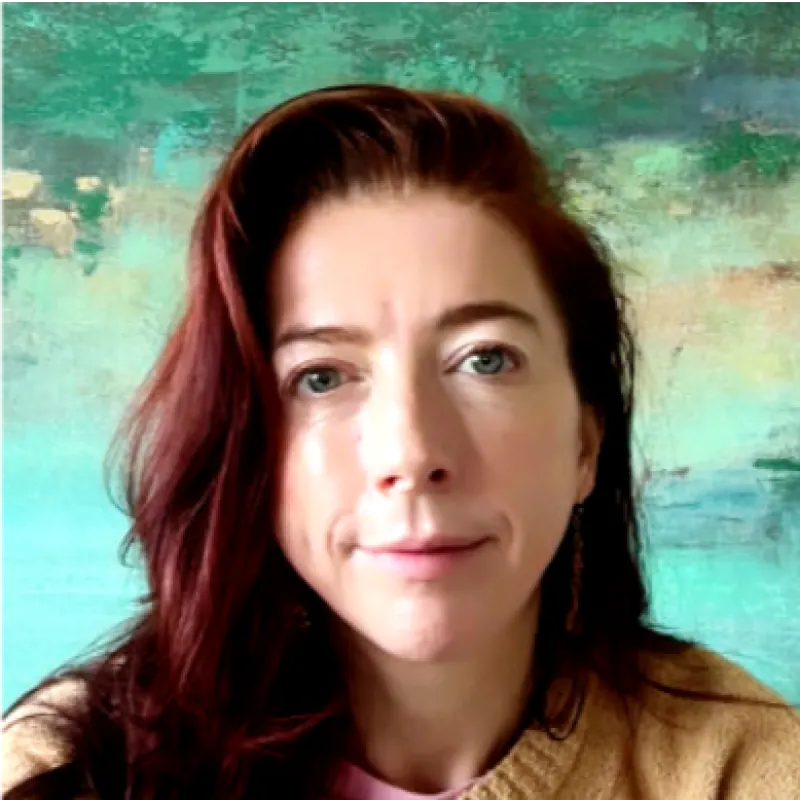
Carolyn Sinsky received a PhD in comparative literature from Yale, where she received the Vardis & Opal Fisher Fellowship and the Prize Teaching Fellowship for excellence in teaching literature and writing. She has taught literature and writing at Yale, the Fashion Institute of Technology, the Great Books Summer Program at Stanford, and Stanford Continuing Studies.
In this course, she brings that experience to Homer’s storytelling and to the poem’s questions about identity, power, intimacy, violence, mortality, and return.
More about CarolynCourse information
Cameras are optional, and no one will be called on unexpectedly. The first 50 minutes will be recorded; open discussion will not.
Cancel in writing by 5:00 p.m. Central on August 18 for a refund less nonrefundable card-processing fees. After that date, tuition is nonrefundable, but registration may be transferred before the first meeting.
Automated captions will be available, cameras are optional, and course materials will be supplied in accessible digital formats.
One-to-one study
Five weeks shaped through close reading and conversation
Tutorial enrollment includes the full group course, along with five additional 90-minute conversations and an individualized path through the poem. The central question is developed through selected passages in the first paid meeting.
We meet live on Zoom for five Tuesdays—August 25 and September 1, 8, 15, and 22, 2026—from 5:30–7:20 p.m. Pacific / 7:30–9:20 p.m. Central / 8:30–10:20 p.m. Eastern.
Emily Wilson’s translation of The Odyssey, published by W. W. Norton, will be our common edition. The recommended paperback ISBN is 978-0-393-35625-0, but print, ebook, audiobook, and library copies are all welcome; no physical book is required. Wilson’s ebook is available through Apple Books and other major ebook retailers. A free, well-formatted public-domain verse translation by William Cullen Bryant is available through Standard Ebooks. Weekly guides will identify the key passages, and brief excerpts needed for close reading and translation comparisons will be supplied.
You may follow the course through the key passages in each weekly guide, or read or listen to the poem in full. The full weekly assignment generally takes about 2½–3½ hours, depending on your translation, format, and pace. Reading every page is not required, and you will be able to follow the lectures either way. Please read or listen to the key passages from Books 1–4 before the first meeting if possible.
No. The course is designed for attentive general readers. No knowledge of Greek, classics, or literary criticism is expected. Necessary literary, historical, and cultural context will be introduced in class.
No. The recent film and the discussion surrounding it will serve as occasional points of comparison, but the course remains centered on Homer’s poem. No film viewing is required.
Join the conversation or simply listen. Speaking and cameras are optional, and no one will be called on unexpectedly.
The first 50 minutes of each meeting—narrative orientation, interpretive lecture, and instructor-led close reading—will be recorded and shared privately with the class through October 6. The break and open discussion will not be recorded, allowing participants to speak more freely. Participants may not record, transcribe, screenshot, or redistribute class discussion or course recordings.
You will receive the available lecture recording and session guide. These materials cannot reproduce the live close-reading discussion, but one absence should not prevent you from continuing. There are no makeup sessions or individual recaps.
Tuition is $350. You may pay in full at enrollment or in two payments of $175: the first at enrollment and the second due September 8, before the third meeting. Choosing the installment option enrolls you in the complete course and commits you to the full tuition. If the second payment is delayed, Carolyn will contact you directly. Registration remains open through August 30 at 5:00 p.m. Central. Participants enrolling after August 25 will receive the Week 1 guide and access to the recorded portion of the first meeting.
Cancellations received in writing by 5:00 p.m. Central on August 18 will be refunded less nonrefundable card-processing fees. After August 18, tuition is nonrefundable, but registration may be transferred to another participant before the first meeting.
No. This course is independently offered by Carolyn Sinsky and is not affiliated with, sponsored by, or administered through Stanford Continuing Studies.
Tutorial enrollment includes the five-week group course plus five additional 90-minute one-to-one conversations and an individualized reading path. The guiding question begins to take shape through selected passages in the first meeting. Read about one-to-one study.
If you would like to take the course and tuition is a barrier, please email Carolyn. A small number of reduced-tuition places may be available, and no detailed explanation is required.
From former students
On learning with Carolyn
Selected anonymous comments from former students.